Selvakir
Selvakir (Primatus Leonis)
AKA Pridemane, Hornback, Old-Forest Fel
Selvakir are large, lion-bodied primates and Ephron's oldest fully sapient species, native to the dense equatorial and subtropical forest interior of the planet. They combine the frame and power of a great felid with the dexterous forelimbs, social complexity, and expressive faces of a higher primate, producing a form with no clean Earth analogue. Their ecological role is that of a keystone social predator and territorial steward: a species whose movement through a forest regulates prey populations, maintains old-growth canopy structure, and suppresses runaway competition between rival groups through stable pride-territory borders. They are Mammalia, warm-blooded and live-bearing, with dense musculature and complex neurological architecture. Arkafelari were created, in part, from Selvakir morphic biology, a fact that shapes every dimension of how fels understand and relate to them.
Appearance
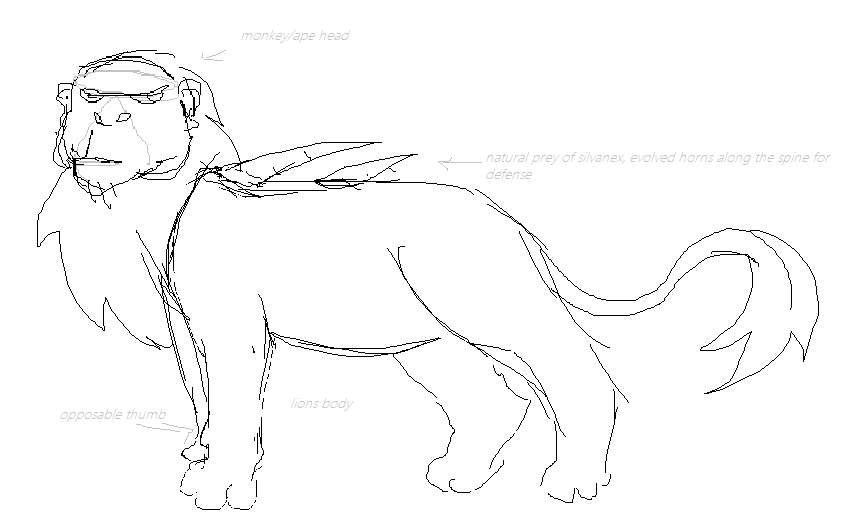
Selvakir stand approximately 1.4 to 1.7 meters at the shoulder on all fours and can rear to nearly 2.5 meters upright on their hind legs, a posture used only in threat displays and during tool use. Adults weigh between 140 and 220 kilograms, with significant variation between individuals and prides. In Ephron's 0.76g gravity this mass is carried easily, the animal's movement fluid and deceptively light for its bulk.
The body is broadly leonine from the chest back: a deep, broad ribcage, a short and powerful lumbar spine, and hindquarters built for explosive speed and upward leaping into the canopy. The forelimbs diverge sharply from any felid analogue. They are proportionally longer, the forearm notably more flexible, and the five-fingered forepaws bear true opposable thumbs capable of fine grip and object manipulation. Their gait is digitigrade on the hindlimbs and variable on the fore, knuckle-walking during fast travel and open-palmed when moving carefully through undergrowth or during social interaction. They climb, brace, grapple, and manipulate objects with a dexterity that early human observers found unsettling.
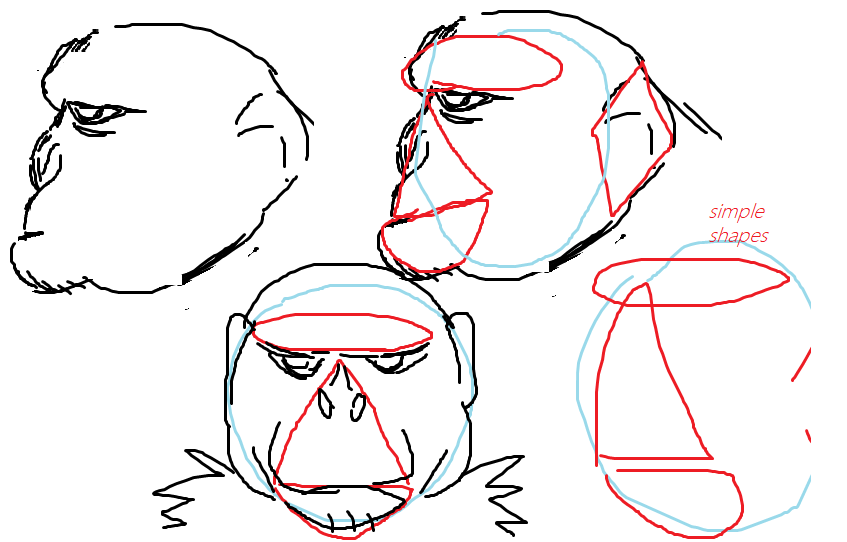
The face is flat and broad for an animal of this size: ape-like, with a wide orbital span, a reduced muzzle, and a mobile, expressive upper lip. The brow ridges are pronounced but not jutting. The eyes are large and forward-facing, deep amber to pale gold in most individuals, with vertically slit pupils that dilate to near-circular in low light. The ears are rounded and set high, capable of significant independent rotation. Their expressions are readable in the way of a creature capable of strategic deception: they communicate what they choose to communicate and mask the rest.
The defining anatomical feature is the horn row. Beginning at the base of the skull and running to mid-back, Selvakir grow a ridge of broad, recurved osseous projections: not keratin horns, but dense bone extensions of the dorsal vertebrae capped with a hardened, slightly translucent cartilaginous material. These grow throughout the animal's life and are not shed. In juveniles they are low and rounded. In prime adults they curve outward and back, each angled to deflect a downward strike from above: a Silvanex diving on an adult Selvakir's spine meets a gauntlet of deflecting surfaces rather than a clean landing zone. The horn row is also a social display structure; older, larger projections signal age and status, and pride members assess one another partly through the height and curve of this ridge. The horns carry no nervous tissue and breaking one, while painful, is not catastrophic. Unlike the morphic horns of Arkafelari, they are not Eilan organs.
Fur is coarse, dense, and golden-brown, ranging from pale straw in individuals from drier forest margins to deep tawny ochre in those from the interior canopy. Subtle dark striping runs along the backs of the legs and flanks, not vivid banding but a tonal deepening that breaks the body outline in dappled light. The face tends to be slightly lighter around the eyes and mouth, giving expressions higher contrast against the fur. There is no mane in the Earth lion sense; instead, the fur around the neck and chest is noticeably thicker and coarser in adults, providing some protection against bite injuries in territorial disputes. Selvakir have no bioluminescent tissue. On a world where nearly everything glows under a double-full moon, they remain entirely dark, a fact Arkafelari Diviners note with interest.
Phenotypes & Regional Variants
No formally documented subspecies exist. Regional variation in coloration is consistent and broadly correlates with forest type: pale straw individuals in drier marginal forest, deep ochre in closed equatorial canopy, with intermediate tones across the gradient. Horn row development varies by age and health within populations rather than by region. No lunar morph has been recorded.
Biology & Evolution
Ephron's 0.76g gravity makes the Selvakir's body plan metabolically viable in a way it would not be in higher gravity. A 200-kilogram frame carrying a large primate brain case, thick horn row, and powerful leonine hindquarters requires significantly less skeletal density here than an equivalent form on Earth would need. Their bones are not hollow in the manner of Ephron's avian species, but are less dense than mass comparison would imply, optimized for load-bearing and impact absorption. Their leaps are substantial: a prime adult clears four to five meters horizontally from a standing launch and descends from canopy heights that would injure a comparable Earth animal without significant harm.
Selvakir have a high resting metabolism that elevates further during territorial displays and active hunts. Healing rate is above the Ephron baseline: superficial wounds close rapidly, and infections that would disable smaller fauna rarely become systemic in a healthy adult. Their respiratory tissue is sensitive to smoke, and their aversion to open fire exceeds what intelligence alone would predict. Ephron's oxygen-rich atmosphere makes this sensitivity consequential; a fast-moving fire in closed canopy is one of the few threats that causes large Selvakir groups to move with genuine urgency rather than cautious deliberation.
The 30-hour day organizes Selvakir activity into a biphasic pattern. Peak activity falls at dawn and the early morning hours; a midday rest follows during peak equatorial heat; a second moderate activity window runs through the afternoon and evening before the pride settles for the night. The midnight watch is not a habitual activity period. Selvakir sleep through it consistently, though their hearing is acute enough that unusual sound will rouse them. The pride's social sleeping cluster functions as distributed alertness without deliberate sentinel posting.
Breeding behavior is not locked to the lunar cycle in the strict sense, but Eilan surge sensitivity in Selvakir morphic biology produces a measurable pattern: conception rates are observably higher in the weeks surrounding double-fullness, suggesting the surge affects reproductive tissue as it does in other species with active morphic cores. Pride behavior shifts during these periods, with boundary patrols increasing in frequency and inter-pride vocal communication becoming more elaborate. This is almost certainly the Eilan-heightened sensory environment amplifying territorial instinct rather than deliberate awareness of the moons, but the effect is consistent.
Selvakir are vocal across a wider frequency range than their anatomy suggests. Their calls carry several kilometers through Ephron's dense atmosphere, and pride communication across large distances is routine. They use layered vocalizations, deep chest-resonant tones for distance signaling and higher close-range calls for social nuance, exploiting atmospheric sound transmission in a way that makes territories aurally defined long before they are physically enforced. Selvakir are the originators of Eerothi. Their lineage is considered ancient and phylogenetically stable: they exhibit the characteristics of a living fossil whose core body plan has changed little across geological time, though regional populations show the expected degree of ecological adaptation.
Behavior & Eilacon
Selvakir are diurnal and crepuscular. Dawn is their peak period: prey is most active, the air is coolest, and light levels suit their forward-facing vision. They hunt, travel, and interact most intensively in the first eight to ten hours after sunrise, rest through mid-day, then resume moderate activity through the afternoon and evening hours.
Social structure is organized around the pride's elders. Prides are built around a core of two to four experienced, long-established individuals and their offspring across multiple generations. The most socially established of these is the Bérāvāst, the Eerothi term for the pride's primary caretaker and decision-holder, who holds priority over food, territory decisions, and den site selection. The role belongs to whoever has accumulated the deepest knowledge and the most social trust within the group; it clusters around long-established caretakers with histories of raising young, but is not determined by reproductive biology alone. Pride members outside the core occupy a looser orbit, patrolling the territory periphery, responding to boundary challenges, and integrating into the core through established social bonds. Unrelated individuals attempting to join without prior social integration are driven off or killed.
Territories are large: the core range of a five-member pride in healthy forest covers 80 to 120 square kilometers, and are overlapping rather than exclusive. Two prides sharing a transitional zone typically avoid simultaneous use of the same locations through scent marking and vocal scheduling. Physical conflict between prides is uncommon and targeted; threat posture, horn-row display, and coordinated vocalization resolves most disputes before contact. When conflict escalates, it is fast and aimed at forcing retreat rather than killing. Selvakir have evolved under Silvanex predation pressure long enough that protracted, high-intensity intraspecific conflict has been consistently selected against.
Communication is multimodal: vocalizations ranging from deep resonant warning calls to complex mid-range social speech with identifiable individual signatures; body posture and horn-row orientation conveying status and intent; and scent marking through glands at the throat and inner wrist, deposited on vegetation at boundary sites. Selvakir recognize one another's voices, remember social history with specific prides, and operate with a clear theory of other minds, calibrating behavior based on what other individuals are likely to intend.
Selvakir Eilacon is receptive and notably well-developed for a non-sapient species. They do not direct or emit Eilan intentionally, but they are sensitive to environmental gradients in ways that reliably shape behavior. They consistently avoid imprint-dense ground without apparent reason, routing around old battlefields, sites of mass death, and locations of unusually high Eilan concentration as though the quality of the air has changed. They approach but do not enter Fonts; prides whose territory includes one treat it as a fixed void in their ranging pattern, routing around it even when the direct path through would be substantially shorter. During double-fullness Eilan surges, senses sharpen and social interactions intensify; a pride that has been calm for turns will begin moving restlessly the day before double-fullness registers on any other available measure. Arkafelari naturalists treat this behavioral shift as one of the more reliable biological indicators that a surge is imminent. Diviners who have examined Selvakir at range describe their Eilan signature as clean and unusually coherent, with none of the fragmentation common to species whose Eilacon is weakly developed, and note its structural resemblance to an early or precursor form of the Arkafelari morphic core system.
Diet & Feeding
Selvakir are apex omnivores in the canopy-forest ecosystem. Their primary animal prey is mid-to-large fauna: Brackhogs taken by coordinated group ambush from elevated positions, Stiltjaws isolated at forest margins, and Riftails taken when easy opportunity presents itself. They hunt Glimmervoles and Mossrunners opportunistically, too small to justify coordinated effort but taken quickly when encountered, and also take Chirruks from roosting positions and Fletchbirds mid-flight. Nightsongs are occasionally caught near water at dusk.
Plant intake is substantial. Selvakir actively forage for Sunfruit and Star-Apple during Vernal and early Solstice when both are fruiting heavily. They consume Honeynut when accessible, cracking shells with the heel of the palm against hard surfaces, and browse Velvetshade groundcover during Hibernal when canopy fruit is scarce. They have been observed stripping and consuming the inner bark of Silvervein trees during extended dry periods, likely for water content and Eilan density rather than caloric value, as the effort-to-return ratio is poor for bulk nutrition. They do not consume Necrocaulis-infected tissue and will abandon an otherwise healthy kill if infestation is detected; this behavior appears to be learned and is transmitted within prides.
Eilan-rich foods are preferentially sought. Selvakir consistently choose ripe Mooncherry over unripe Honeynut even when the latter is more abundant and show clear preference for prey that has been feeding in high-Eilan environments. Whether this represents active Eilacon-guided selection or simply differential sensory response to Eilan-rich tissue is unresolved. Seasonal diet shifts are significant: Solstice brings peak fruit abundance and reduced hunting pressure, with prides ranging wider and tolerating brief inter-pride contact during this window. Hibernal drives a contraction toward reliable food sources, with hunting effort increasing and inter-pride tolerance dropping sharply.
Predators & Threats
The primary predator of Selvakir is the Silvanex, and the rear anatomy of the species is a record of that pressure. The horn row is an anti-Silvanex adaptation: the Silvanex's primary kill method, a spine or neck strike, becomes unreliable against any adult Selvakir in good condition with a full horn row. Juveniles, whose horn rows are still low and rounded, are significantly more vulnerable. Prides position young centrally during rest and respond to Silvanex circling with immediate cluster behavior, adults forming an outward-facing ring with juveniles inside and horns elevated, making clean targeting by a diving Silvanex nearly impossible.
The relationship with Silvanex is not simple predation. Silvanex strike instigators of conflict, and Selvakir have evolved under that pressure long enough that their conflict resolution behavior reflects it: the preference for vocal and postural resolution over physical contact, the brevity of actual combat when it occurs, the consistent de-escalation behavior in most territorial encounters. A Selvakir that escalates a dispute to sustained aggressive contact in Silvanex territory has historically had lower survival odds. This evolutionary pressure acts from two directions simultaneously: Silvanex behavior has shaped Selvakir social structure, and Silvanex predation culls the most aggressive individuals from the gene pool over generations.
Necrocaulis infection is the principal biological threat. Selvakir in territories bordering bloom zones face seasonal exposure; adults resist initial infection better than smaller fauna, but a compromised individual with repeated exposure will eventually succumb. Prides in affected territories relocate seasonally rather than remaining in Necrocaulis-dense areas during peak bloom. Forest fire, amplified by Ephron's high-oxygen atmosphere, is an acute environmental threat with near-no-warning; Selvakir cannot coordinate an organized response and simply flee, sometimes sustaining severe respiratory damage in thick smoke. Volcanic activity in seismically active range disrupts territory structure and drives displacement that increases inter-pride competition in surrounding regions. Human arrival constitutes a historical threat of a different category: early colonists hunted Selvakir and contested their territory during the Resource Wars. By the present era, Selvakir populations have been reduced to scattered remnant groups in deep wilderness, far from human and actively contested Arkafelari-human border zones.
Reproduction & Lifespan
Breeding occurs year-round with a pronounced peak during Latevernal and Earlsolstice, when food abundance is highest and the Eilan surge of the preceding double-fullness has subsided into a stable elevated baseline. Gestating-capable individuals come into fertility for a window of three to five days, detectable to pride members by changes in scent signature and behavioral shifts. Mating is not exclusive within a pride and involves no long-term pair bonding.
Gestation runs approximately fourteen Ephron semesters, just over one Ephron year. Litters are almost always one cub, occasionally two, never three. Selvakir cubs are born large and neurologically advanced relative to most Mammalia: eyes open within three days, weight-bearing capability within two semesters. Nursing and care is shared across all established adults in the pride core throughout the juvenile period. Cubs are not permitted to join boundary patrols until their horn row reaches functional deflection height, a threshold requiring approximately thirty to thirty-five semesters. Full adult status is reached between forty and fifty semesters. Lifespan in undisturbed conditions reaches 45 to 60 Ephron years; in practice, most wild Selvakir die earlier from environmental hazard, territorial injury, or chronic Necrocaulis exposure in degraded habitat.
The death of a Bérāvāst causes significant structural disruption. The next most experienced caretaker assumes the role without obvious conflict, but the transition period carries elevated vulnerability: patrolling becomes inconsistent, boundary marking lapses, and opportunistic Necrocaulis incursion or pressure from neighboring prides increases. The pride's accumulated environmental knowledge, held in the memory of its most experienced members and transmitted through direct social learning rather than any external record, does not fully transfer. If the carrier dies before transmission is complete, the knowledge is gone.
Habitat & Range
Selvakir are forest interior specialists native to Ephron, concentrated in equatorial and subtropical biomes with high canopy density, substantial mid-canopy structure, and stable year-round water access. They avoid open scrub, grassland margins, and disturbed secondary growth: in closed canopy they can hear a Silvanex's descent in time to cluster; in open ground they cannot.
Their geographic range prior to human arrival covered equatorial forest bands across Ephron's interior continents, with populations extending into subtropical montane forest where canopy density remained sufficient. That range has contracted sharply. Present populations are concentrated in the deepest, least-accessible interior forest, in regions where Arkafelari free colony presence is also relatively recent and human settlement has not reached. Their range does not typically overlap with active Arkafelari colony centers, though it may overlap with the outer territories of expanding free colonies. Selvakir detect the presence of Arkafelari colonies through sound signature, scent, and the altered Eilan pattern of inhabited ground, and route around them. Whether this avoidance is fear-based, Eilacon-driven instinct, or learned social knowledge transmitted within prides is unclear; it is likely all three.
Ecological & Societal Roles
Selvakir are keystone predators and territorial stabilizers in the equatorial forest ecosystem. Their hunting regulates Brackhog and Stiltjaw populations, preventing overgrazing of forest floor and mid-canopy groundcover. Their territorial behavior keeps large fauna distributed broadly rather than clustering around high-resource zones in ways that would degrade them. Their scent-marking and vocalization patterns function as environmental signals for other species: Riftails alter movement patterns in response to Selvakir call activity, and Fletchbird nesting site selection in some regions correlates with proximity to active pride boundaries, possibly because Silvanex striking behavior is suppressed near pride cores. At death, a Selvakir releases an Eilan payload comparable in density to several smaller fauna combined, enriching local soil and supporting high-Eilan flora regrowth. Imprints from Selvakir deaths persist longer than those of most fauna, a fact Diviners note without yet fully explaining.
Selvakir hide is coarse, thick, and highly durable, among the most wear-resistant materials available from any hunted Ephron fauna. Processed correctly, it produces leather capable of deflecting light blade strikes. Selvakir bone is dense by Ephron mammal standards and is used in tools, weapon hafts, and structural elements in cultures that hunt them. The horn caps, carved from the osseous dorsal projections, hold a faint residual Eilan charge that Diviners use in invocation work, less potent than Silvanex feathers but more accessible. Fat rendered from kills has traditional uses in wound sealing and cold-season food preservation. The meat is consumed but is not valued as a delicacy: it is dense, strongly flavored, and requires long preparation. Most Arkafelari who hunt Selvakir do so with coordinated group methods and considerable preparation; an adult at bay is extraordinarily dangerous, the horn row functioning as a close-range weapon when a Selvakir is cornered, and the combination of primate intelligence, strategic spatial awareness, and leonine power makes a hunt that goes wrong go very wrong.
Sighting a Selvakir in healthy forest is a recognized good omen: an indicator that the environment is intact and correctly ordered. The Arkafelari understanding that they are a product of Selvakir morphic biology is not hidden; it is taught as part of colony origin history. The complication is the layer beneath: they were created by humans who used Selvakir biology as raw material, and that fact is entangled with the eighth sin, the arrogance of reshaping life to serve the needs of the powerful. A Selvakir sighting therefore carries a double weight, health and balance in the forest and a reminder of what was taken, altered, and used without consent. Some colonies read it as straightforwardly affirming. Others find it haunting. Both responses are considered valid.
Society & Culture
Selvakir society is organized around the pride, which functions as the fundamental social, territorial, and knowledge-holding unit. The pride is not a simple family group but the repository of several generations of accumulated environmental knowledge, held in the memory of its most experienced members and transmitted through direct social learning. A pride that loses its Bérāvāst loses this knowledge capital, and rebuilding it takes years. There is no external record; if the carrier dies before transmission is complete, that knowledge is gone.
The Bérāvāst is the pride's most established caretaker, whoever has nursed the most cubs, held territory the longest, and accumulated the deepest relational knowledge of the forest and neighboring prides. Selvakir share the same broad reproductive biology as the Arkafelari descended from them: gestating-capable individuals, non-gestating contributors, and those whose biology falls between or outside these poles. Pride leadership is not determined by reproductive category. It defers, generation after generation, to demonstrated knowledge and social trust.
Selvakir speak Eerothi, the language that Arkafelari later adopted and built their written tradition from. Their Eerothi is oral and contextual, rich in the vocabulary of territory, kinship, danger, and the natural world, and transmitted through social learning rather than any written record. The Arkafelari codification of Eerothi into a written system with formal grammar and lexicon is, in a meaningful sense, an act of learning the language of their ancestors.
Tool use is consistent and heritable within prides. Selvakir use stones to crack Honeynut shells, stripped branches to probe hollow trees for Glimmervoles and Mossrunners, and have been observed propping branches against steep inclines to create ramps for accessing otherwise unreachable canopy fruiting sites. These are transmitted techniques learned through observation of older pride members, not innovations made in the moment. A pride with a long-established Bérāvāst demonstrates consistently more sophisticated tool use than a younger group, supporting the argument that Selvakir tool knowledge is cultural in origin.
Their relationship with Arkafelari in the present era is one of mutual avoidance and careful distance. Selvakir do not appear to distinguish Arkafelari from humans as categories: both are large, bipedal-capable, fire-using creatures that arrive with noise and altered-Eilan presence, and both are routed around. Individual Arkafelari naturalists who have spent extended periods near wild prides report gradual, limited habituation: a pride that becomes accustomed to a quiet, non-threatening presence at distance and ceases to alter its behavior in response. This habituation does not generalize to other Arkafelari and resets rapidly if the relationship is broken. Among free colony Arkafelari with deep-wilderness presence, a developing ethic of non-interference with Selvakir territories exerts strong cultural pressure without yet constituting codified law in most colonies. The reasoning is partly practical (disturbing a pride attracts Silvanex attention, as territorial disruption reads as conflict instigation) and partly ecological (a thriving pride within colony territory is a visible sign that the land is healthy and the colony is not overreaching; a pride in visible decline is read as an early warning of ecological degradation).
The Selvakir's place in the eighth sin teaching is specific and consistent across most colony traditions. They are the creature invoked when the sin of playing god is discussed: not as victims in a simple moral tale, but as witnesses. They were here before Humanity. They were taken apart and used. They are still here, diminished but intact, in the deep forest.
Field Notes
At a Glance: A lion-bodied primate the size of a draft horse, sapient, armed with a spine of recurved bone horns, and speaking the language Arkafelari borrowed for their written tradition. A sighting in healthy forest is an omen of balance and a reminder of what was taken to make the Arkafelari.
Key Facts:
- Appearance: Ape-flat face on a leonine body, golden-brown fur with subtle flank striping, and a dorsal ridge of recurved osseous horns running skull to mid-back: low and rounded in juveniles, outward-curving and prominent in prime adults. No bioluminescence, which stands out on a world where nearly everything glows.
- Behavior: Dawn-active with a midday rest and second crepuscular window; sleeps through the midnight watch but rouses fast. Pride conflict resolves through vocal and postural escalation before contact. An adult at bay, cornered and using its horn row as a weapon, is extraordinarily dangerous.
- Eilan Signature: Receptive and unusually coherent; avoids imprint-dense ground and routes around Fonts without crossing them. Pride restlessness and increased patrol frequency in the day before double-fullness is one of the more reliable biological indicators a surge is imminent.
- Threat Level: Not aggressive toward characters moving quietly through territory. A pride that begins openly monitoring a character has already decided something is wrong.
- Seasonal/Lunar Shift: Latevernal into Earlsolstice breeding peak; inter-pride tolerance rises during Solstice abundance and contracts sharply in Hibernal. Double-fullness heightens senses and territorial intensity across the board.
Quick Use: Arkafelari scavenge kills rarely and carefully: hide, bone, and horn caps are the material value, not the meat. A pride in visible decline within colony territory is read as a warning to examine the colony's own resource use.
Seen With: Brackhogs and Stiltjaws as primary prey; Silvanex as primary predator, the horn row exists entirely in response to that pressure; Fletchbirds, whose nesting site selection correlates with proximity to active pride territories.
© 2019 - 2026 Henry Marie Brown. All rights reserved.